

The Script That Can Actually Be Made for $1M
Empowering writers, directors, producers and any creative wanting to understand how to write to a pricepoint that makes sense for their project.

When I was searching for a feature script to anchor Green Light Ready, I reached out to a contact at the Black List specifically looking for films that could realistically be made for under $1M. And, as I shared in this reel, $1M in the US is a completely different ballgame than shooting somewhere with cheaper labor and incentives. Both paths have their pros and cons.
Of the dozen or so scripts submitted, I could tell within 15 pages that pulling it off at that price point, while honoring what made the script special, would be nearly impossible. Not because of the writing, but because of the cast, locations, and elements that seem simple on the page but would require far more resources than a $1M budget realistically allows.
After reading through everything, one script rose to the top. It scored highly on the Black List, and I knew it was the perfect material for this course. Not just because it’s a great concept, but because I genuinely believe it can be made well for under $1M — and I’m going to show you exactly why.
The class kicks off next week!
We arrive having read the script, discuss the tricky elements, build the schedule, and construct the budget from scratch, look at financial projections, and peep at a sample waterfall. By the end you’ll see not just what it costs, but how even a script like this — contained, specific, with a clear point of view — is doable but still no cake walk.
I’m excited too that the writer is walking away with a basic schedule and budget built by me to help them on take their next step. That’s what supporting indie film looks like!
The ability to read a script and gauge cost takes years to develop. But there are signposts. And those signposts can be taught.
What does it actually mean to write for a price point?
Screenwriting courses teach craft: structure, character, dialogue, scene work. This course does something adjacent but different. It helps you understand what your script is actually asking the world to do in order to exist.
Every scene you write is a production decision. The barn at dusk with six speaking roles and a working tractor isn’t just a dramatic choice. It’s a specific location, a permit, probably a company move, maybe a split shoot day, a trained animal wrangler, and six contracts. An intimate two-hander in a single apartment is a gift to a producer, but can also be a cinematically underwhelming experience. The cross-country road trip with twenty locations across three states is a beautiful idea that will eat your budget before you hit page 60.
This doesn’t mean don’t write the barn scene. It means understand what you’re asking for when you do, and know when it’s worth it and when there’s a smarter way to get to the same emotional truth.
A schedule and budget is not a cage. It’s a creative constraint. And constraints, as any seasoned filmmaker will tell you, are often where the most interesting work lives.
Jaws was full of constraints.
Obsession was full of constraints.
It also shot in 20 days in LA on a $750K budget. (caveat: six reshoot days were added, so the total spent is likely a bit higher).
What Green Light Ready gives writers specifically
If a screenwriting course makes you a better writer, then Green Light Ready makes you a more empowered one.
When you understand how a schedule is built, you start to see your own script differently. You notice the company moves. You feel the night exteriors. You understand why consolidating locations isn’t just a budget decision. It’s often a storytelling one too.
When you understand what things actually cost, you stop writing with vague ambition and start writing with intention. You can choose to go big on one scene because you know where to pull back somewhere else. You understand the trade-offs before you’re sitting across from a line producer hearing them for the first time.
And when you understand the basics of financial projections and what distribution actually looks like for a sub-$1M film, you stop writing for an imaginary greenlight and start writing for the real one. The one that’s actually possible, and that sets your producers up to raise financing for a movie that can get made.
Knowing the limitations is where creativity flourishes.
KEY TAKEAWAYS 🔑
How to read a script like a line producer
How to create a basic schedule and budget
How the schedule impacts the budget
Pros and cons of union vs. non-union
How to get a film made for under $1M
Basic financial projections and recoupment waterfalls
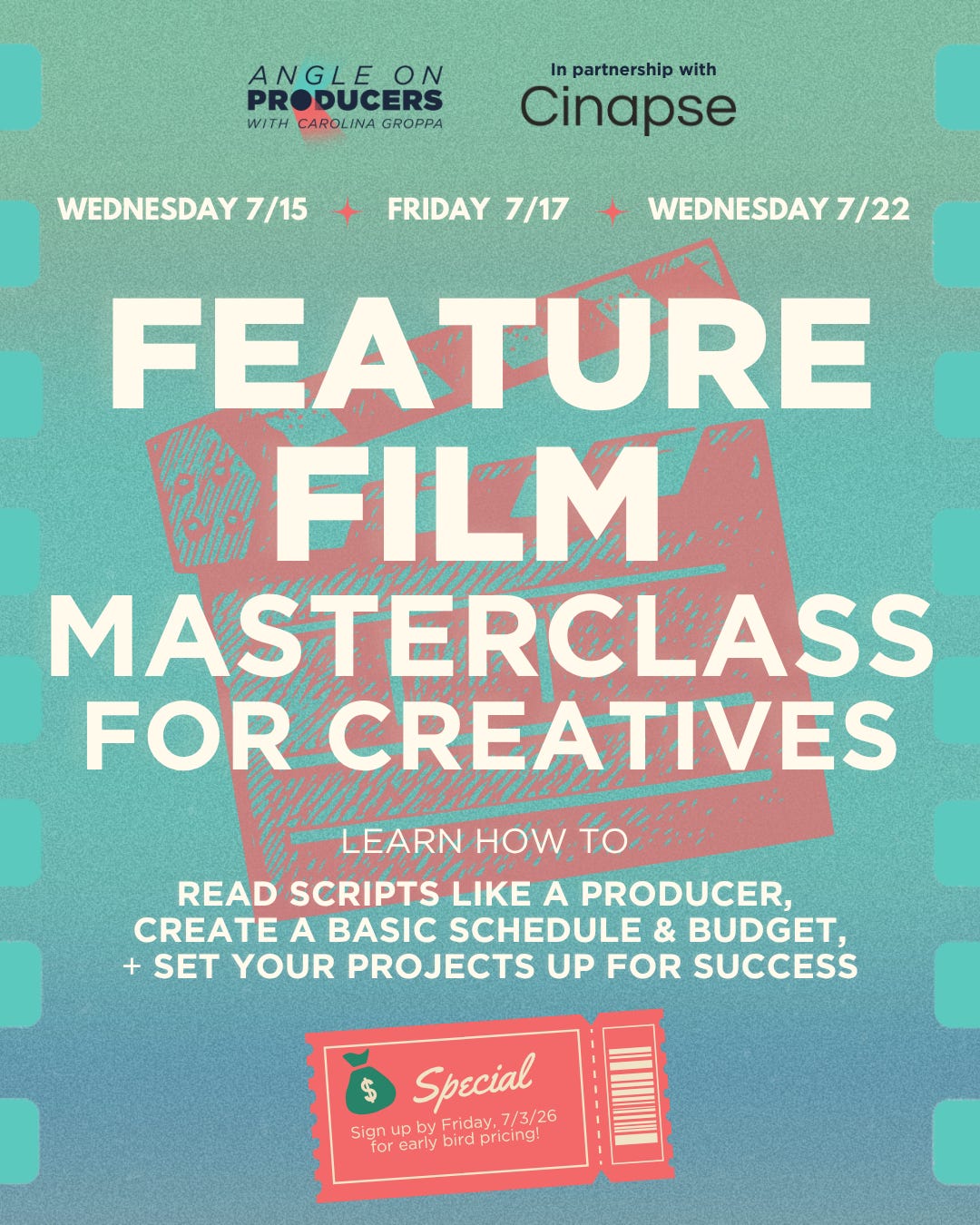
Green Light Ready — a 3-part live and virtual masterclass
The class runs July 15, 17, and 22 from 10A - 12PM PST. A recording will be sent out after if you can’t make it live! Thanks to our partners at Cinapse, you’ll get a free trial of their scheduling platform plus 15% off when you sign up.
Enrollment closes July 10th. Sign up!
Keep creating, keep hustling. And as always, thanks for doing this life thing with me!


I relate "writing for a price point" to, "writing for a page length". Just today, I had a good think on how, when I write to fit a page length, the flow is choppy and the story suffers, as a worry, *will this fit the page*?. So too, I imagine, can writing for a price point.
The answer, IMO, is to have a proper team around the writer/s. A team who limits the writer's creativity to fit a budget, time, etc., instead of, say, a writer/s taking on the task to limit themselves.
Cool post!